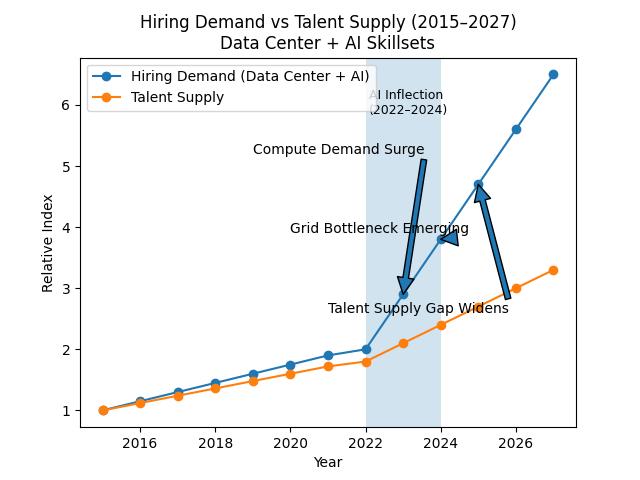
There is a growing gap between hiring demand, data center expertise, and the speed at which renewable and energy infrastructure needs to scale.
We’re not just talking about scaling solar or wind anymore. The conversation has moved upstream to power, grid access, and infrastructure capacity itself. As highlighted in this Axios coverage on data center investment rivaling energy sectors, capital flowing into data centers is now on par with oil, gas, and renewables, driven largely by AI infrastructure demand. That shift alone is reshaping how energy systems are being built and financed.
At the same time, we’re seeing increasing pressure on the grid and broader energy systems as AI demand accelerates. Data centers are expected to drive a significant share of power demand growth this decade, reinforcing that infrastructure, not generation alone, is becoming the constraint.
What’s clear is that AI infrastructure and electrification are accelerating demand faster than energy infrastructure can keep up. Power is becoming the bottleneck.
We’re seeing this play out directly at Sea Change in the hiring curve. There has been a sharp increase in demand for talent with data center sales experience, grid expertise, and adjacent technical skill sets across energy, infrastructure, and AI. These roles were often in the background just a few years ago. Now they are some of the most urgent and difficult to fill.
But this is not the data center talent profile from the 90s or early 2000s.
The candidates who stand out today are those who have evolved with the market. They understand both software and hardware, have stayed close to the shifts in AI, engaged early, and understand what it means to co-locate power and compute. They’ve been part of the push toward infrastructure convergence across energy, data centers, and grid systems.
This is not just a right candidate, right time dynamic. It reflects how investors are shifting as well. Capital is increasingly flowing toward companies that can navigate grid constraints, manage power intelligently, and integrate across energy, data, and infrastructure ecosystems.
What is also becoming increasingly clear is the cost dynamic. The best candidates in this space are in extremely high demand and often managing multiple offers at once. Companies that are not prepared to move quickly with a competitive package are losing out. Hiring at this level now requires not only precision in fit, but a willingness to pay top of market for talent that can operate across software, hardware, and infrastructure.
The quality of the product and the ecosystem that ultimately reaches the data center now matters more than ever.
The winners are not just those building renewable energy assets. They are the ones unlocking capacity, managing constraints, and enabling the next layer of infrastructure that supports AI-driven demand.
And increasingly, the talent that can operate at that intersection is becoming the most valuable piece of the equation.