The narrative around EVs right now is noisy. Depending on who you ask, the market is either collapsing or accelerating.
The truth sits somewhere in between.
EVs are not disappearing. But the market is going through a reset.
From 2020 through 2024, growth was driven by incentives, capital availability, and aggressive OEM expansion. In 2025 and into 2026, we are seeing a correction. U.S. EV sales are down roughly 25 to 30 percent year over year in early 2026. Several OEMs have pulled back production and delayed programs. At the same time, federal incentives are shifting, and consumer demand is becoming more price sensitive.
That is the surface level story.
Underneath it, something more important is happening.
Infrastructure is still scaling.
There are now over 192,000 public chargers in the United States. Fast charging capacity has grown roughly 40 percent since 2023, with more than 18,000 new fast chargers added in 2025 alone. Investment has not stopped. It has shifted.
The industry has flipped from demand driving infrastructure to infrastructure enabling demand.
That shift matters.
It signals a move toward a more durable phase of growth where utilization, reliability, and economics begin to matter more than expansion for its own sake.
At the same time, EV adoption is not stalling long term. The global EV fleet is expected to reach approximately 116 million vehicles by 2026. In the United States, the path toward 50 percent EV sales by 2030 remains intact, though likely at a more measured pace.
The market is consolidating. Tesla continues to hold a dominant share. Several OEMs are pulling back. The next phase will favor companies that can operate efficiently at scale and deliver lower cost vehicles.
Growth is also shifting segments.
Consumer adoption is no longer the only driver. The fastest growth is now coming from fleets, logistics, and infrastructure heavy use cases. These segments have clearer economics and stronger incentives to electrify.
The bottleneck has moved.
It is no longer vehicles. It is infrastructure.
Charging reliability, grid constraints, and interconnection delays are now the primary constraints on growth. This is where capital is flowing.
The largest share of investment is moving into power and grid infrastructure. Transmission, substations, and interconnection capacity are becoming the foundation for everything else.
Charging infrastructure continues to scale, but more selectively. Investment is concentrating in high utilization corridors, fleet depots, and sites paired with storage.
Fleet electrification is accelerating, particularly in logistics and commercial vehicles. These deployments are capital intensive but economically rational.
Battery and storage systems are becoming increasingly important as they bridge the gap between supply and demand across both EV and grid use cases.
Layered on top of all of this is AI.
AI is not replacing EV investment. It is competing with it and accelerating the need for infrastructure.
Data centers are driving a significant increase in power demand. That demand is forcing utilities and developers to expand grid capacity at a pace that was not anticipated even a few years ago.
The result is convergence.
EVs, AI, and electrification all point to the same constraint. Power infrastructure.
Looking ahead to 2027, the picture becomes clearer.
The EV market will have fewer winners. Vehicles will become more affordable. Growth will resume in a more rational way.
Infrastructure will be more reliable and more profitable. Capital will continue shifting away from vehicles and toward power, grid, and integration.
The takeaway is straightforward.
The market is not slowing down. It is reallocating.
The real winner is not EVs or AI. It is the infrastructure that supports both.
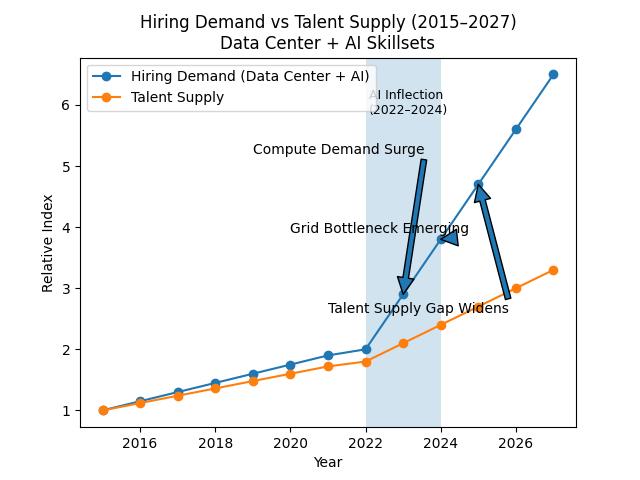
For companies operating in this space, the implications are immediate. Capital deployment is increasing. Projects are getting more complex. Hiring is becoming more competitive.
The constraint is no longer vision or funding. It is execution.
And execution requires people who know how to build.