The capital has made up its mind. In August, Andreessen Horowitz announced its $1.1 billion Machine Age fund, dedicated to the physical buildout of AI: chips, memory, networking, systems software, power, and the machines that bring intelligence into the real world. When one of the most software-centric firms in venture history raises a billion-dollar vehicle for hardware and energy, that is not a trend piece. That is a signal.
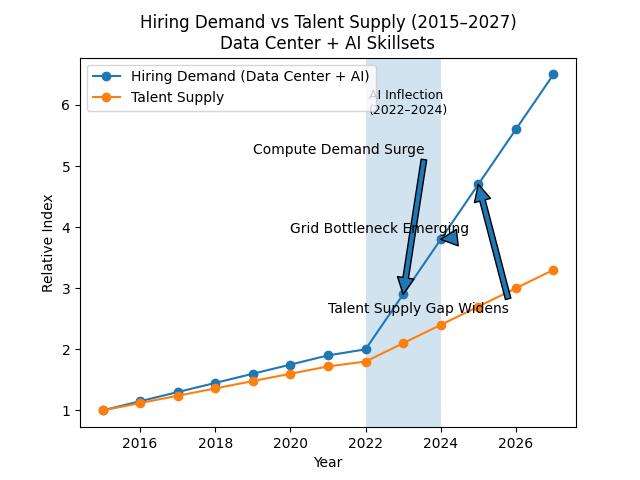
We have spent fifteen years recruiting for the companies that live where software meets physical systems, in energy and climate tech, from seed through Series B. So while the headlines are about the money, what we see every week is the other side of the ledger: the people. And here is the honest version. The capital is arriving faster than the talent, and the gap is widening.
Where the Money is Going in Energy
Three recent rounds tell the story of what investors are rewarding in physical AI for the energy sector.
- Gecko Robotics: Raised $125 million at a valuation above $1 billion for its wall-climbing robots and the AI platform behind them, turning inspection data from power plants, tanks, and critical infrastructure into predictions about where assets will fail. What made Gecko stand out was years of unglamorous field data collected in harsh environments, fused into software operators trust with maintenance budgets.
- Phaidra: Closed a Series B of more than $50 million, led by Collaborative Fund with NVIDIA participation, for AI agents that autonomously control industrial cooling and energy systems, including the data centers that AI itself runs on. Phaidra stood out because its models operate directly in live plants where bad decisions have physical consequences. That is a bar most “AI for industry” companies never clear.
- Gridware: Raised a $55 million growth round for pole-mounted sensing hardware and grid-listening AI that catches faults and wildfire risks before disasters strike, with utilities deploying at scale across the country. Gridware stood out because it built its own hardware to generate a proprietary physical dataset no one else has, then made the software indispensable to utility operations.
Notice the pattern. None of these companies won on model architecture. They won on the fusion of hardware, physics, and software, proven in environments that punish mistakes. That pattern is exactly why hiring is so difficult.
What Founders Ask For, and What the Market Holds
When a newly funded physical AI founder opens a search, the spec almost always describes one person who is really three people.
- A senior mechanical or electrical engineer with a decade in power systems, robotics, or industrial controls.
- A production-grade ML engineer who has shipped models that run in the real world.
- Someone fluent in the customer domain, whether a refinery, substation, or data center hall.
Ten years of each experience, available now, in this city, at startup equity economics. The market does not hold that person in any volume. Training pipelines barely exist, and universities still separate disciplines. The power industry spent two decades under-hiring, concentrating deep experts who are now senior and settled. Meanwhile, ML talent is priced by AI labs and hyperscalers at levels a Series A cannot and should not match. Everyone fishes in the same small pond, and it is not refilling fast enough.
The real question is not how to find the unicorn. It is what to look for instead.
After hundreds of searches, our answer is consistent:
- Hire for boundary crossing: The engineer who moved from aerospace controls into ML or firmware into power electronics, has proven the skill that matters most: the ability to master a second discipline to a professional standard.
- Prioritize first-principles physics and systems thinking: Choose foundational understanding over tool familiarity —frameworks change every eighteen months, but thermodynamics does not.
- Design around pairs and pods: Combine a domain expert beside an ML engineer with shared outcome ownership, rather than waiting for a single hire embodying both.
Why These Hires Are So Competitive
Supply is structurally thin, and demand just went vertical. Every dollar of that $1.1 billion, and the billions following it from other funds, converts into requisitions for identical profiles: power electronics engineers, controls engineers, robotics engineers fluent in ML, and ML engineers who respect physical constraints.
Defense tech, EV and storage, grid modernization, data center buildouts, and physical AI startups are all bidding simultaneously. These candidates do not apply. They are courted continuously, hold multiple offers, and choose based on leadership learning and ownership scope, not just compensation. If your process takes six weeks, you were never in the running.
Build the Engineer You Cannot Buy
Here is the part most funded founders underinvest in, and it is the highest-yield move available: invest in your own people. The winning companies stopped treating deep knowledge as something acquired solely through hiring and started treating it as something manufactured internally.
- Close the 20 percent gap: Hire the engineer who is 80 percent ready and build the remaining skills deliberately with a named owner and timeline.
- Put software teams in the field: Send engineers to the plant, substation, or commissioning trip because nothing teaches physical constraints like standing next to the machine.
- Codify tribal knowledge: Run internal teaching cadences where domain veterans turn their expertise into learning materials absorbed in weeks rather than years.
- Implement dual mentorship: Pair every ML hire with a domain mentor and every domain hire with an ML mentor, making collaboration a core part of the job description.
- Fund Education: Pay for deep coursework and industry certifications on work time.
The return is deeper than skill acquisition. When engineers see real investment in their professional growth, you secure true buy-in, and dedication. People stay where they are growing. They also tell their former colleagues, and in a market this thin, your reputation as the company that develops its engineers becomes your best sourcing channel. Training budgets read as a cost. In physical AI, they are the cheapest talent acquisition and retention spend you will ever make.
The Bottom Line
The Machine Age will be built by companies that treat talent strategy with the same rigor as their technology roadmap. Write specs for real humans, hire for proof of learning velocity, pair disciplines instead of waiting for unicorns, and invest in your existing engineers — because they are the ones who will train the next fifty.
The capital has arrived. The companies that solve the people problem will be the ones still standing when it is deployed.
Sea Change Talent partners with seed to Series B companies across energy, climate, and hard tech. If you are staffing a physical AI team, we have probably already met your next hire.